Showing posts with label identity. Show all posts

Saturday, October 21, 2006

new books

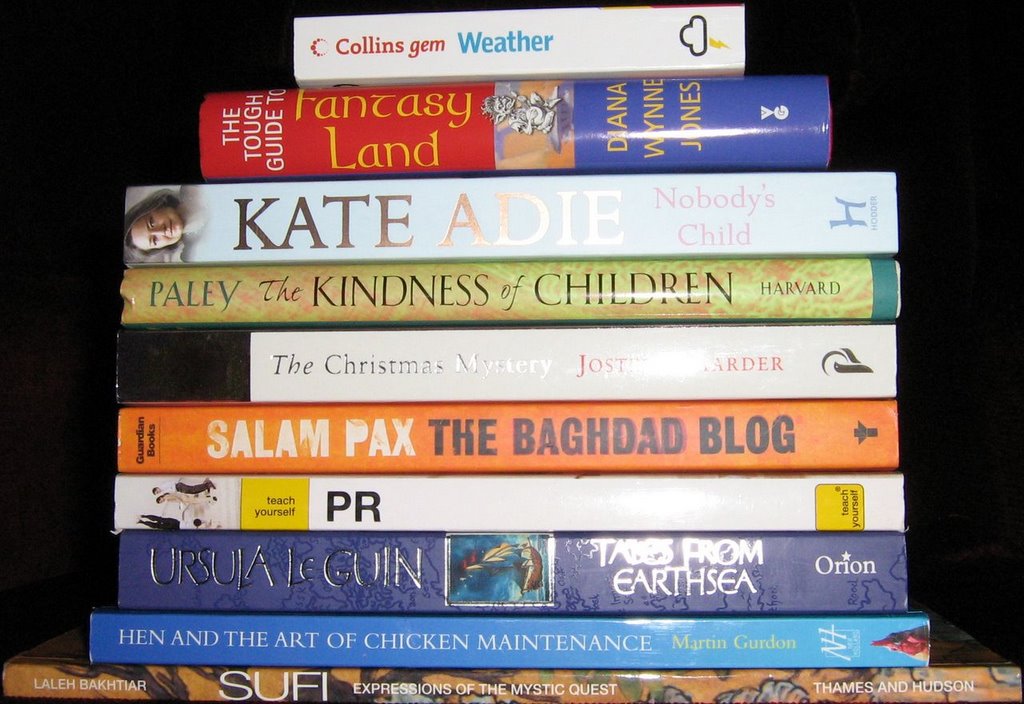
There was a big booksale on today, which I went to, and bought some books. But not as many as I thought I might.
My attitude to books has changed interestingly over the last few years.
Now that my reading list is longer than I can reasonably expect to ever get through, and there is so much reading material freely available, and other media that I want to absorb, it no longer seems worth just buying anything vaguely interesting looking. I've come to realise that the probability of actually reading the book, or being able to use it some other way (such as giving it away, or lending it out) is very important too.
So, this is what I came out with today, along with why:

  • Collins Gem Weather - a guide to interpreting the sky, and what it's done, is doing, and is likely to do. This would be a nice skill to have, especially as I never watch the weather, and I like to cycle. I bought this book in order to increase my natural intepretive skills.
  • The Tough Guide To Fantasy Land - This is basically a glossary of roleplaying terms and culture I think. I bought this book because it looks simple to read, reasonably entertaining, but mainly because it should give me a better understanding of role-playing, and hence one of my best friends. I bought this book in order to understand someone else.
  • Nobody's Child - This is a book of Kate Adie's experiences of orphans. I have a lot of respect for Kate Adie, and I don't know much about orphans. I bought this book to learn more about Kate Adie, and through her, humanity.
  • The Kindness of Children - The premise of this book is: 'Are children wiser about the nature of kindness than we think they are?' I don't think my society has the right attitude to children, hence books like this that challenge the social outlook seem likely to me to be good sources of truth and wisdom. I bought this book to learn more about humanity, and what humanity could be.
  • The Christmas Mystery - Jostein Gaarder, writer of Sophie's World, writes well, thoughtfully and entertainingly. I haven't been reading enough fiction lately either, which has been tiring me out I think. Also, Sophie's World connects back to an important time in my past: reading this might reveal/grow some important links, and enable some sort of progression. I bought this book to relax with, and help set my life in better context.
  • Salam Pax, The Baghdad Blog - A text that I'd like to have about me simply because I think it has historical importance: the emergence of independent internet journalism via blogging. Also, I expect there's some pretty interesting stuff in here concerning the situation in Iraq. I bought this book as a historical memento, and to flesh out my impression of the Iraq conflict.
  • Teach Yourself PR - I bought this book because having a better working knowledge of PR should let me interact with PRed organisations more effectively. In a world where big organisations impact our lives a lot, this should be a useful skill.
  • Tales From Earthsea - This was on my to buy list already: I read the first three Earthsea books already, and loved them, and they influenced me significantly. I bought this book to continue an ongoing thread of my life, be entertained and thought provoked. Ursula K Le Guin is an awesome writer and thinker. Anything she's written is on my reading list.
  • Hen and the Art of Chicken Maintenance - I loved Zen and the Art of Motorcycle Maintenance, and I am involved with keeping chickens, so this seems like a nice book to have. I bought this book to see how I align with the rest of the chicken keeping community, and hopefully to get a better feeling for the relationship between humans and other animals.
  • Sufi - Family friends raised Sufism in my consciousness recently, and got me interested. I know next to nothing about Sufism, so I bought this book to increase my awareness of humanity, and its customs.
So there we are. A whole bunch of books, motives, and future reading for me...

Saturday, September 02, 2006

Martial Arts, Games and Learning

A common criticism of martial arts (as studied by the layperson, rather than the military etc.) is that 'the moves would never help you in a real fight'. This has never been a problem for me. My reason for training is not to obtain fighting skills as quickly as possible, but to gradually obtain movement skills and gain mastery over my body (in a less domination-centric terminology: to unite my mind with my body) over a long timescale.
So although the things I'm learning currently won't help me out in a mugging, they might help me use my body with more awareness and care, for myself and others. Perhaps I'll drive more safely, not push myself or others beyond our limits, and grow older with better health, etc.
I'll be fitter, mentally and physically, and a more effective member of society than I otherwise would have been.
So, my message to the martial artists who want to fight: Give up martial arts. Get out onto the streets and get into fights. That's how to learn to fight. You'll make the 'right' friends, and be engaging in the right activities to do 'well' in real fights.
To the martial artists: Perhaps you will be a better fighter eventually. But I think that's missing the point. Your martial art can be of far more value to you in your everyday life.
I'm sure many people understand this, but I think many don't as well.
The reason the moves we learn (at the beginning stages) in martial arts wouldn't help in a real fight is that they're very contrived. Both parties have to cooperate a lot in order to make the first steps in learning. What do these contrived moves do? They give us a sense of what's possible, extend what's possible, and allow us to practice and develop fundamentals that will be useful in a freer context.
I am discovering the same thing in maths and Go. Although a game of Go is almost infinite in its possibilities, without a study of the fundamentals, the range of accessible possibilities is much reduced. And maths is so open-ended that you can wander round in circles forever unless you impose some sort of order on your endeavours somehow.
And to take it to its extreme: life is the most open-ended chance anyone ever gets. To fail to transfer the lessons learned from more restricted activities would be to close off the possibilities of the universe!
I never knew a board game could be so illuminating. Perhaps it takes a board game like Go. (And stepping stones, in the form of maths and martial arts...)

Monday, September 19, 2005

letting things come to me

Since I've become more aware of the Web2.0 revolution, I've noticed more and more web technologies that I'd been thinking about years ago rising to the surface. A key example was an idea I had about online libraries where you list your books, and then other people can browse your library and if appropriate make requests to exchange or borrow books. It would be like an enormous communal, virtual bookshelf, except you'd get to read real books instead of reading off a computer screen (which despite what anyone says is still less comfortable than reading a book! at least to a majority of users...).
Well, now we have Listal, LibraryThing and AllConsuming. I'm not sure who owns them and whether I really want to commit my data to them, but the services are definitely there and doing what I thought such services should do years ago.
Which brings me to my main point. With services like these, I shouldn't have to think about committing my data. My data should reside where I want it to, and I should allow these services access to my data on my terms and conditions.
We need some sort of a platform for maintaining information, and then transforming it and submitting it. Preferably in a relatively extensible and/or standardized way. XML and XSLT style technologies seem to be screaming out to be used in this sort of position.
In addition, we need some sort of voluntary code of conduct whereby we can be reasonably assured that we can reliably dictate the terms under which such services can use our data. Maybe some open source datakeeper software modelled on recent digital rights management advances, so that as well as records companies being able to control our rights on the music we license from them, we can also revoke other organisation's rights on the data they license from us.
Digital rights management isn't necessarily a bad thing, but biased towards the goals of the powerful it is clearly not a good thing.
So the data landscape of the future? Data residing in multiple incarnations on various storage devices across the world, controlled by open source datakeeper software allowing only authorised people to access it, and transform it, using flexible tools. The owners of the data - you and me in addition to the organisations and corporations - empowered by our data's newfound mobility and flexibility.

Tuesday, August 23, 2005

a brief manifesto (for myself)

The computing substrate seems to be improving at an ever increasing rate. But there are some things that I think need improving, some on the level of user education, others technological. Here are a few that spring to mind:

  • Provision of parallel architectures that are actually properly designed
    We have amazing bleeding edge facilities nowadays. Progress is rampant, and in all directions, like bacterial colonies on agar jelly. We have various standards groups like the W3C trailing behind doing their best to mop up the spillage, but how good is it? The ideas mill is in overdrive, now all we need is groups to set these ideas in their proper places.
    I'm not advocating design fascism, but I am advocating the more widespread rolling out of bulletproof architectures that the military wouldn't be afraid to use.
    The secret to success is to realise that there are only a very few tricks in the book, but that those tricks are extremely powerful. The ideas mills churn out specific permuations. Someone needs to run along behind spotting the underlying patterns, and making simple but highly generalised tools that the rest of us can use without wading through piles of barely distinguishable competing 'standards' and hacks.
    Any contenders that I'm not aware of yet?
  • Data awareness
    Our data shadows are burgeoning. Technologies need to be developed that protect our data, and maximise its effectiveness. I have separate user profiles on multiple social websites. When will I be able to store my profile locally, and allow websites to access it when I wish, and allow them to store their own copies only if I allow them to? Decent data management would make the computing substrate so much more useful. I wouldn't have old data all over the internet crying out to be maintained. I could participate in a far wider variety of stuff. Service providers could concentrate on what they were good at, not on recollecting all the various data that everyone is tired of giving for the umpteenth time anyway.
  • Better documentation
    All due respect to the wikis of this world. But the linking systems are beginning to show their age. We need real databases with real tagging systems, and proper diagram support. Why are we still relying on bitmaps on the web? Macromedia's solution is a poor stopgap. What happened to SVG? A few more diagrams would help reduce the mess the ideas machine spews out, and improve quality for us all.
In a word, integration. We need to allow everything to be a whole lot more cohesive and consistent, while maintaining the exciting churning hotchpotch of creativity that provides us with the ideas that need organising in the first place.